

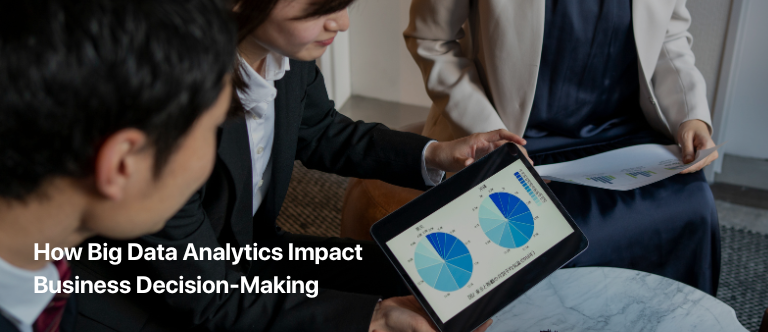
Big data analytics has become one of the most powerful forces shaping modern business strategy. Instead of making decisions based on intuition alone, companies now rely on data insights, predictive models, and real-time reporting to understand markets, customers, and internal operations with unmatched clarity.
From improving customer experiences to forecasting trends and optimizing operations, big data in decision-making is reshaping how organizations grow and compete.
This guide explains how big data analytics impacts business decision-making, the benefits, use cases, challenges, tools, and a detailed case study.
What Is Big Data Analytics?
Big data analytics refers to the process of collecting, processing, and analyzing extremely large and varied datasets to uncover patterns, relationships, and insights that support business decision-making.
It typically includes:
- Predictive analytics
- Real-time data processing
- Machine learning
- Business intelligence (BI)
- Data visualization dashboards
- Data mining techniques
These tools turn raw data into actionable insights that leaders can use to make smarter choices.
Why Big Data Matters in Modern Business
Companies today face rapid changes in customer behavior, economic conditions, and market competition. Big data provides clarity by enabling businesses to:
- Predict outcomes
- Personalize experiences
- Minimize risks
- Optimize costs
- Improve operational efficiency
- Innovate faster
Organizations using data-driven decisions consistently outperform competitors relying on outdated or incomplete data.
How Big Data Analytics Impacts Business Decision-Making
Below are the major ways analytics improves decision-making across industries.
Improves Accuracy With Data-Driven Insights
Traditional decision-making often relies on assumptions, incomplete reports, or outdated information. Big data analytics provides real-time and historical data to remove guesswork.
Businesses gain clarity on:
- Customer behavior
- Market demand
- Competitor performance
- Seasonal trends
- Financial patterns
Example: A fashion retailer uses historical and real-time data to forecast product demand for winter collections, reducing excess inventory and maximizing sales.
Strengthens Predictive Decision-Making
Predictive analytics uses algorithms and machine learning models to forecast future outcomes. Leaders can anticipate opportunities and threats before they happen.
Predictive insights include:
- Sales forecasting
- Customer churn predictions
- Market trend forecasting
- Risk scoring
- Equipment failure predictions
Impact: Companies make proactive decisions rather than reactive ones.
Enables Real-Time Decision-Making
Real-time data analysis helps businesses respond instantly to emerging issues or opportunities.
Real-time applications:
- Dynamic pricing in e-commerce
- Fraud detection in banking
- Instant route optimization in logistics
- Live inventory management in retail
- Real-time ad performance tracking
This speed improves agility and reduces operational delays.
Enhances Customer Experience and Personalization
Big data reveals detailed customer insights, allowing businesses to tailor experiences and improve satisfaction.
Data reveals:
- Purchase patterns
- Engagement behavior
- Product preferences
- Customer sentiment
Impact: Personalized recommendations, targeted campaigns, and increased retention.
Reduces Operational and Financial Risks
Big data analytics helps identify emerging threats early.
Risk areas improved by analytics:
- Fraud detection
- Credit risk scoring
- Market volatility
- Supply chain disruptions
- Compliance risks
Companies gain better control and avoid costly mistakes.
Optimizes Operations and Efficiency
Analytics reveals inefficiencies and helps companies streamline processes.
Operational improvements:
- Automated workflows
- Predictive maintenance
- Resource optimization
- Staff productivity insights
- Cost reduction strategies
This leads to better performance with lower operational costs.
Supports Long-Term Strategic Planning
Big data strengthens top-level decision-making in areas such as:
- Market expansion
- Product innovation
- Budget planning
- Workforce management
- Investment strategies
Leaders rely on accurate insights instead of risky assumptions.
Benefits of Big Data Analytics for Business
| Benefit | Description |
| Better decision accuracy | Decisions grounded in factual data |
| Reduced costs | Optimized operations and resource planning |
| Faster decision-making | Real-time analytics and automation |
| Enhanced customer loyalty | Personalized engagement strategies |
| Competitive advantage | Insights competitors don’t have |
| Higher revenue | Optimized pricing, sales, and marketing |
| Lower business risk | Predictive and preventive analytics |
Types of Big Data Analytics Used in Decision-Making
- Descriptive Analytics - Explains what has happened.
- Diagnostic Analytics - Explains why something happened.
- Predictive Analytics - Predicts what may happen next.
- Prescriptive Analytics - Recommends the best actions for desired results.
Real-Time Analytics Chart
Real-Time Data → Analytics Engine → Insights → Instant Decisions
| | | |
Sensors, CRM, AI/ML Models Dashboards Automated Actions
Web Logs
Industries Using Big Data for Decision-Making
Retail
- Big data analytics is widely used in retail to improve customer experience and operational efficiency.
- Inventory forecasting: Helps retailers predict demand accurately, reduce stockouts, and avoid overstock situations.
- Personalized recommendation engines: Uses customer behavior data to deliver tailored product suggestions that increase conversions.
- Dynamic pricing: Adjusts product prices in real time based on demand, competition, and buying patterns to maximize sales and profit.
Finance
- The finance industry relies heavily on analytics to reduce risks and improve decision-making.
- Fraud detection: Identifies unusual patterns and flags suspicious transactions instantly to prevent financial losses.
- Credit scoring: Evaluates customer creditworthiness using a wider range of data points for more accurate loan decisions.
- Automated trading decisions: Uses algorithms and real-time data to execute trades faster and more efficiently than human traders.
Healthcare
- Healthcare organizations use big data to improve patient outcomes and optimize clinical operations.
- Predictive diagnosis: Analyzes patient data to forecast potential health issues before symptoms worsen.
- Treatment personalization: Tailors medical treatments based on patient history, genetics, and response patterns.
- Hospital workflow optimization: Improves resource allocation, reduces wait times, and enhances overall hospital efficiency.
Manufacturing
- Big data helps manufacturers streamline operations and ensure product quality.
- Predictive maintenance: Predicts equipment failures before they occur, reducing downtime and repair costs.
- Supply chain analytics: Monitors supplier performance, demand fluctuations, and logistics to optimize the entire supply chain.
- Quality control: Detects defects and inconsistencies early using real-time data from sensors and production lines.
Logistics
- Logistics companies rely on analytics to improve delivery efficiency and reduce operational costs.
- Route optimization: Identifies the fastest and most cost-effective delivery routes using real-time data.
- Fuel cost reduction: Analyzes driving patterns, routes, and vehicle performance to minimize fuel consumption.
- Delivery time prediction: Uses traffic, weather, and historical data to accurately estimate delivery times and enhance customer satisfaction.
How Businesses Can Implement Big Data Analytics
Implementing big data analytics requires a strategic, step-by-step approach. When done correctly, it transforms raw information into high-value insights that drive smarter, faster, and more confident business decisions.
Step 1: Identify Key Business Goals
Before adopting any analytics tools, companies must define their core objectives. Clear goals ensure data projects remain focused and aligned with business needs.
Questions to consider:
- What challenges are we trying to solve?
- Which decisions currently rely on guesswork?
- Where do inefficiencies, risks, or customer gaps exist?
- What outcomes do we want to improve—sales, retention, productivity, or forecasting?
Examples of actionable goals:
- Reduce customer churn
- Improve demand forecasting
- Optimize marketing spend
- Detect fraud faster
- Enhance operational efficiency
A strong foundation ensures analytics tools are used effectively rather than collecting unused data.
Step 2: Gather High-Quality Data
Data quality determines the accuracy of insights. Businesses should collect reliable, relevant, and timely information across all departments.
Common data sources include:
- CRM data: Customer interactions, purchase history, support logs
- Website analytics: Browsing behavior, session activity, conversion paths
- IoT sensors: Equipment performance, temperature, movement, logistics data
- Sales records: Transaction data, revenue patterns, product trends
- Market data: Industry benchmarks, competitor activity, economic indicators
- Social media insights: Customer sentiment, engagement metrics, trending topics
Best practices:
- Ensure data comes from trusted, consistent systems
- Remove duplicate or outdated entries
- Integrate sources for a 360-degree view
- High-quality data leads to high-quality decisions.
Step 3: Use Advanced Analytics Tools
To convert data into insights, businesses need powerful analytics platforms. The right tools allow teams to analyze large datasets, run predictive models, and visualize trends quickly.
Popular analytics tools include:
- Google BigQuery: Large-scale data analysis and fast SQL queries
- Apache Hadoop: Distributed data storage and processing
- Apache Spark: Real-time analytics and machine learning
- Tableau: Visual dashboards for non-technical users
- Power BI: Interactive reports and business intelligence
- Cloud platforms (AWS, Azure, Google Cloud): Scalable analytics environments
What these tools help with:
- Real-time reporting
- Predictive modeling
- Data visualization
- Machine learning experiments
- Automated decision systems
Choosing the right platform depends on business size, data complexity, and budget.
Step 4: Build Dashboards & Predictive Models
Once tools and data are in place, visualization and modeling bring insights to life.
Dashboards provide:
- Clear views of KPIs
- Trend charts and performance metrics
- Real-time alerts and updates
Predictive models enable:
- Sales forecasting
- Customer churn predictions
- Equipment failure alerts
- Risk scoring
- Demand planning
These dashboards help leaders understand complex data instantly and take action without waiting for manual reports.
Step 5: Create a Data-Driven Culture
Technology alone isn’t enough—companies must adopt a mindset that values data-backed decisions.
How to build this culture:
- Train employees to interpret dashboards and analytics
- Encourage teams to support opinions with data
- Integrate analytics into daily workflows
- Set KPIs and performance targets based on insights
- Promote collaboration between IT, operations, marketing, and leadership
A strong data culture ensures analytics becomes a strategic advantage, not just a technical tool.
Challenges of Using Big Data in Decision-Making
Even with its advantages, big data analytics comes with challenges that businesses must overcome.
Data Privacy Issues
Companies must comply with regulations such as GDPR, HIPAA, or regional privacy laws. Mishandling sensitive data can lead to fines and reputational damage.
Poor Data Quality
Incomplete, inconsistent, or outdated information leads to inaccurate insights. Businesses need strong data governance and cleaning processes.
High Implementation Costs
Setting up analytics infrastructure, hiring skilled professionals, and integrating systems may require significant investment—especially for large-scale deployments.
Lack of Skilled Data Professionals
Data scientists, analysts, and engineers are in high demand. Many organizations struggle to hire or retain specialists capable of managing complex analytics environments.
Integration Challenges With Legacy Systems
Older databases, outdated software, and disconnected systems make it difficult to centralize data. Compatibility issues slow down implementation.
Planning ahead helps reduce these barriers.
Organizations that build strong governance frameworks, invest in the right tools, and upskill their teams will unlock the full potential of big data analytic, leading to better insights, smarter decisions, and long-term competitive advantage.
Future Trends: What’s Next for Big Data Decision-Making?
The future of business decision-making will be shaped by rapid advancements in artificial intelligence, automation, real-time analytics, and data ecosystems. As organizations continue to adopt smarter technologies, big data will evolve from a supportive tool into a core foundation of strategic decision-making.
Below are the key trends that will redefine how businesses use data in the coming years:
Advanced AI-Driven Decision Engines
AI is moving beyond predictive insights and evolving into automated decision engines that can analyze data, recommend actions, and even execute decisions with minimal human input.
What this means for businesses:
- Faster and more accurate decision-making
- Reduced human error
- Automated operational adjustments
- Smart resource allocation
Example: AI systems adjusting production schedules automatically based on demand trends and supply constraints.
Autonomous Business Operations
Automation is expanding across industries. With big data and AI working together, businesses will run large parts of their operations autonomously.
Key capabilities include:
- Self-managing supply chains
- Automated customer service workflows
- Real-time risk detection and mitigation
- Dynamic pricing and inventory management
Impact: Organizations will operate with fewer bottlenecks, lower costs, and greater scalability.
Deeper Real-Time Personalization
Personalization will go far beyond simple recommendations. Businesses will leverage real-time behavioral data, location information, and sentiment analysis to create highly tailored experiences.
Examples of future personalization:
- Automated product bundles based on individual preferences
- Real-time content personalization on websites
- Dynamic promotions triggered by user behavior
- Location-specific customer experiences in offline stores
Result: Higher customer satisfaction, loyalty, and conversion rates.
More Accurate Predictive Modeling
As data volumes increase and machine learning models advance, predictive analytics will become more precise and context-aware.
Future enhancements include:
- Improved anomaly detection
- Contextual risk modeling
- Predictive maintenance with near-zero errors
- Hyper-accurate demand forecasting
Impact: Businesses will be able to anticipate market shifts, customer needs, and operational risks with unprecedented accuracy.
Wider Use of Generative AI for Insights
Generative AI will play a major role in transforming how businesses interpret and act on data.
What generative AI will help with:
- Creating summarized insights from complex datasets
- Automating report generation
- Enhancing data storytelling
- Providing natural-language explanations for analytics
- Assisting non-technical teams in understanding trends
Example: AI systems generating complete strategy reports based on real-time data analysis.
Greater Focus on Data Governance
As data becomes more critical and regulations tighten, organizations will prioritize data governance, ensuring security, accuracy, and ethical use.
Key governance priorities:
- Data transparency and traceability
- Stronger cybersecurity measures
- Compliance with global regulations
- Ethical AI and analytics frameworks
- Improved data access controls
Why it matters: Poor governance leads to privacy risks, legal challenges, and damaged trust. Strong governance strengthens long-term data strategy.
The Future Outlook
The next generation of big data decision-making will be defined by automation, intelligence, and ethical data management. Businesses that embrace these trends will benefit from faster innovation, stronger competitiveness, and deeper market insights. Those that resist change risk falling behind as data continues to shape the future of every industry.
Conclusion
Big data analytics is reshaping how companies think, operate, and grow. With the ability to deliver real-time insights, predictive intelligence, and deep customer understanding, data-driven decision-making is no longer optional, it’s a strategic necessity. Businesses that leverage analytics make smarter choices, reduce risks, improve efficiency, and stay ahead of fast-changing markets.
As organizations continue adopting advanced analytics, platforms like AppLogiQ play a crucial role in simplifying data processes, enabling faster insights, and empowering leaders with the tools they need to make confident, informed decisions. Companies that embrace this data-first mindset will unlock new opportunities, innovate faster, and build a strong competitive edge for the future.
Follow us on Linkedin | Instagram | Facebook or explore more insights at https://www.applogiq.org/