


In today’s fast-moving digital economy, businesses must do more than just adapt—they must innovate. While pre-built tools serve a purpose, they often fall short when it comes to scalability, personalization, and long-term efficiency. That’s where custom web app development services come into play.
Whether you're looking to streamline operations, deliver a unique digital experience, or launch a SaaS product, custom web applications offer unmatched flexibility and performance. In this complete guide, we'll explore everything you need to know about building, launching, and scaling custom web apps through top-tier web application development.
What Are Custom Web App Development Services?
Custom web app development services involve designing and developing web-based software tailored to specific business needs. Unlike off-the-shelf software, these solutions are custom-built from the ground up, offering businesses the ability to control features, user experience, and scalability.
A web application is an interactive software solution accessed via a browser, built using web technologies such as HTML, CSS, JavaScript (frontend), and backend frameworks like Node.js, Python, or Ruby.
These services are typically delivered by a web app development company or a dedicated development team and may include:
- Business analysis
- UI/UX design
- Frontend and backend development
- API integration
- Testing and quality assurance
- Cloud deployment and maintenance
Unlike static websites, custom web application solutions function like software platforms—supporting user interactions, data processing, automation, and integrations with third-party services.
Benefits of Custom Web Application Development
Tailored for Specific Needs
One of the most compelling advantages of custom web application development is its ability to precisely align with your unique business requirements. Unlike off-the-shelf software that serves a general audience, custom web application solutions are engineered specifically for your workflows, customer interactions, and operational goals. This level of personalization eliminates unnecessary features, reduces friction, and streamlines performance across your organization. It allows you to focus resources on what truly drives value—whether that’s improving customer engagement, automating internal processes, or delivering a differentiated user experience.
Scalability by Design
Scalable web applications are built with growth in mind. As your business evolves, so should your technology. Custom solutions are developed using modern architectural principles like microservices, containerization, and cloud-native infrastructure. This ensures your app can handle increasing traffic, user data, and feature complexity without compromising speed or reliability. Whether you're scaling from hundreds to thousands—or millions—of users, a well-built custom app can grow seamlessly with your business, eliminating the need for costly re-platforming or rebuilds in the future.
Better Performance
Performance is a critical factor in user retention, SEO, and conversion rates. Custom web apps are optimized for your specific use case, allowing developers to fine-tune every aspect of the application—from database queries and caching strategies to front-end rendering and server response times. Unlike generic platforms bloated with unused features, custom apps are lean, fast, and purpose-driven. The result is a smooth, intuitive experience for users, reduced bounce rates, and improved operational efficiency across all touchpoints.
Advanced Security
Security risks continue to grow in frequency and complexity. With custom web app development services, you have complete control over your application's security architecture. This includes implementing advanced encryption protocols, role-based access controls, secure authentication methods, and regular code audits. Additionally, your application can be designed to meet industry-specific compliance requirements such as GDPR, HIPAA, or PCI-DSS. This level of control ensures your sensitive data—and your users’ trust—are well protected from evolving threats.
Stay ahead of security threats with industry-recognized best practices from OWASP. Explore trusted guidelines for secure web app development.
This level of control ensures your sensitive data—and your users’ trust—are well protected from evolving threats.
Seamless Integration
Businesses rely on a diverse ecosystem of tools, platforms, and third-party applications to operate efficiently. A major benefit of custom web application development is the ability to integrate seamlessly with these systems. Whether it's a CRM like Salesforce, a payment gateway like Stripe, a marketing automation tool, or a legacy ERP system, custom web apps can be built with robust API integrations that connect your tech stack into a unified digital ecosystem. This improves data flow, reduces manual work, and enhances decision-making with real-time insights.
Cost Efficiency Over Time
While custom web application development may involve higher initial costs compared to out-of-the-box solutions, it often proves significantly more cost-effective over the long term. Custom apps eliminate the need for ongoing subscription fees, licensing costs, and third-party plugin purchases. They reduce dependency on multiple software providers and eliminate inefficiencies caused by patchwork solutions. With a well-planned roadmap, you can incrementally evolve your app as your business grows—maximizing your return on investment and minimizing technical debt.
Types of Custom Web Applications
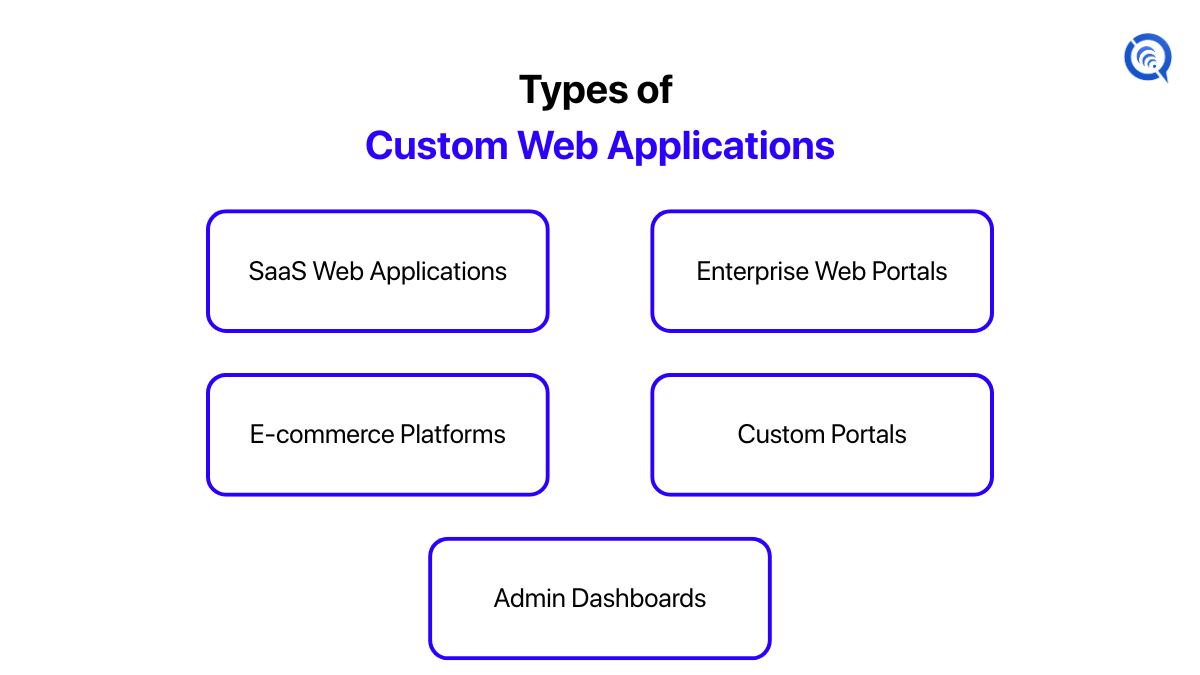
Custom web app development services are highly versatile and can be tailored to support a wide range of digital platforms and industries. From internal business tools to large-scale consumer-facing platforms, these applications are built to address specific functional needs, ensure better performance, and scale with growth.
1.SaaS Web Application
SaaS (Software as a Service) web app development focuses on creating browser-based applications that are accessible anytime, anywhere. SaaS platforms like Slack, Zoom, or Trello are examples of custom-built solutions designed to serve thousands (or millions) of users through a subscription model. These apps are typically multi-tenant, cloud-native, and built with scalability and uptime in mind.
With custom web application solutions, businesses can build their own SaaS products with unique features, pricing models, and user management systems. Whether for external customers or internal users, SaaS web apps streamline workflows, support recurring revenue models, and offer on-demand functionality across devices.
2.Enterprise Web Portals
Enterprise web portals are powerful platforms designed for internal operations, enabling businesses to consolidate and centralize access to data, documents, tools, and workflows. These portals are used by employees, management teams, vendors, and partners to ensure smooth collaboration and real-time communication.
A custom enterprise portal may include features such as HR management systems, project tracking dashboards, document repositories, internal messaging, and more. Custom web app development services make it possible to integrate these features seamlessly into your existing infrastructure while maintaining high security and compliance standards.
3.E-commerce Platforms
For retail and product-based businesses, a standard e-commerce template often lacks the flexibility needed to create a truly unique shopping experience. With a custom web application, you can design every aspect of your e-commerce platform—from the product catalog and checkout experience to back-end inventory management and customer engagement features.
This includes support for multiple currencies, localization, product bundling, user-specific pricing, and integration with third-party logistics or CRM systems. Custom e-commerce web applications empower businesses to build digital storefronts that are optimized for conversions, responsive on all devices, and capable of scaling with growing customer demand.
4.Customer Portals
Customer portals are secure, self-service platforms that give users access to their data, services, or support—24/7. These portals are essential for businesses that offer ongoing services such as telecom providers, utility companies, banks, insurance firms, and B2B service providers.
With custom development, these portals can include robust features such as account overviews, invoice downloads, payment processing, support ticketing, appointment scheduling, and personalized notifications. Built using web-based software development principles, customer portals improve user satisfaction, reduce support overhead, and foster customer loyalty.
5.Admin Dashboards
Admin dashboards are critical tools for business intelligence and system management. They serve as the control centers for internal teams, allowing administrators to manage users, monitor performance, and make data-driven decisions.
Custom admin dashboards often include real-time analytics, data visualizations, user activity logs, permission settings, system notifications, and performance KPIs. By leveraging backend and frontend development, these dashboards can be tailored for any role or department within your organization, ensuring that each user sees only the most relevant data and controls.
Admin dashboards built through custom web app development services are not only more efficient but also more secure and aligned with your company’s unique operational structure.
The Custom Web App Development Process
Every successful custom web application begins with a structured, strategic approach. A professional web app development company will guide you through a multi-phase process designed to ensure alignment with business goals, technical excellence, and long-term scalability. Below is a detailed breakdown of the five key phases involved in delivering high-quality custom web app development services:
Step 1: Discovery & Planning
The discovery and planning phase is the foundation of every successful web application development project. This step involves extensive collaboration between the client and the development team to clearly define the app’s objectives, user base, and technical scope.
Key activities include:
- Conducting stakeholder interviews and market research
- Creating user personas and customer journey maps
- Defining business goals and success metrics
- Outlining must-have vs. nice-to-have features
- Preparing a high-level product roadmap
- Estimating timeframes and resources
This phase reduces the risk of scope creep and misalignment while laying the groundwork for a well-structured, scalable development process.
Step 2: UI/UX Design
In this phase, the focus shifts to user experience and interface design. A clean, intuitive, and visually appealing design is critical for user adoption and satisfaction. Custom web application solutions require tailored UI/UX approaches that align with branding, accessibility standards, and device responsiveness.
Key outputs of this phase include:
- Low-fidelity wireframes to outline layout and navigation
- High-fidelity prototypes for stakeholder feedback
- Interactive mockups created using tools like Figma or Adobe XD
- Style guides to ensure brand consistency
- Accessibility standards for WCAG compliance
Great UI/UX design not only looks good but also supports user goals and business objectives, minimizing friction and enhancing engagement.
Step 3: Frontend & Backend Development
With designs approved, the project moves into the frontend and backend development stage—also known as full-stack web development. This is where your application begins to come to life, both visually and functionally.
Frontend Development:
- Built using technologies like React, Angular, or Vue.js
- Focuses on performance, responsiveness, and accessibility
- Ensures cross-browser and device compatibility
- Implements visual elements from the design phase
Backend Development:
- Developed with Node.js, Django, Ruby on Rails, or Laravel
- Handles business logic, server operations, and database interaction
- Integrates third-party APIs and services
- Manages user authentication, security, and data validation
Together, frontend and backend development create the dynamic, interactive experience users expect from modern web-based software development.
Step 4: Integration & Testing
Once the core features are built, your application enters the integration and testing phase. This ensures all components work seamlessly together and that the app meets functional, security, and performance standards.
Key components of this phase include:
- API integration with third-party tools such as CRMs, payment gateways, and analytics platforms
- Manual and automated testing (unit, integration, regression, and performance tests
- Continuous feedback loops between developers and QA teams
- Cross-platform and cross-browser testing
- Security audits and vulnerability scanning
A rigorous testing process is essential for delivering stable and secure custom web applications that perform under real-world conditions.
Step 5: Deployment & Maintenance
After thorough testing and client approval, the application is ready for launch. During the deployment phase, developers use CI/CD (Continuous Integration and Continuous Deployment) pipelines to automate release processes and push the final version live.
Deployment activities include:
- Hosting setup on platforms like AWS, Azure, or Google Cloud
- Environment configuration (production, staging, development)
- Domain and SSL configuration
- Final quality checks and monitoring setup
- Go-live announcement or user onboarding plan
But deployment is just the beginning. Custom web app development services include ongoing maintenance and support to ensure your platform continues to perform optimally.
Post-launch services typically include:
- Bug fixes and performance tuning
- Adding new features or enhancements
- Monitoring app uptime and usage metrics
- Data backups and security patches
- Scalability planning based on user growth
A professional web app development company stays engaged post-launch to help you iterate quickly and stay competitive in your industry.
Technologies Used in Web Application Development
A successful custom web application relies on the right combination of technologies across multiple layers of the stack. Choosing the right tech stack directly impacts your app’s performance, scalability, security, and development timeline.
| Layer | Technologies | Description |
| Frontend | React, Angular, Vue.js | These JavaScript frameworks power the frontend development of your application, delivering dynamic, responsive, and interactive user interfaces across browsers and devices. They’re crucial for ensuring an excellent user experience in any web-based software development project. |
| Backend | Node.js, Django, Ruby on Rails, Laravel | The backend development layer handles data processing, user authentication, business logic, and server-side functionality. These frameworks support building secure and scalable custom web application solutions with robust APIs and seamless database communication. |
| Database | MySQL, PostgreSQL, MongoDB | These are essential for data storage, retrieval, and management. SQL databases like MySQL and PostgreSQL are great for structured data, while NoSQL solutions like MongoDB offer flexibility for complex or unstructured data—key to scalable web applications. |
| Cloud | AWS, Google Cloud Platform, Microsoft Azure | These platforms provide cloud infrastructure and services for hosting, deploying, and managing custom web applications. Cloud environments allow for flexible scaling, redundancy, performance optimization, and global accessibility. |
| DevOps | Docker, Kubernetes, Jenkins, GitHub Actions | These tools streamline deployment, integration, and continuous delivery. Docker and Kubernetes enable containerization and orchestration, ensuring consistent environments. Jenkins and GitHub Actions automate workflows, speeding up development cycles in full-stack web development. |
| APIs | REST, GraphQL | APIs act as communication bridges between different parts of your application and third-party services. REST is widely used for standard integrations, while GraphQL offers more flexibility and control over data queries—both are essential for modern web application development. |
Why Your Stack Matters
Choosing the right tech stack isn’t just about trendiness—it determines the success and longevity of your project. For example:
- React + Node.js + MongoDB (MERN Stack) is perfect for real-time dashboards or SaaS apps.
- Django + PostgreSQL suits projects requiring high security, such as healthcare or finance.
- Vue.js + Laravel + MySQL can power lightweight, fast MVPs for startups.
Your chosen combination should align with:
- Your business goals
- Expected traffic and data volume
- Budget and development timeline
- In-house or outsourced developer expertise
- Future plans for scaling or integrating additional services
The right stack enables you to build a custom web application that not only performs well today but is also prepared for future growth and innovation.
How to Hire Web App Developers
Hiring the right team is critical to the success of any custom web app development project. Whether you're building an MVP or scaling a SaaS platform, the right talent ensures speed, stability, and scalability.
In-House vs. Outsourced
- In-House: Offers full-time collaboration but comes with higher costs and longer recruitment times. Best for core, ongoing development.
- Outsourced: More flexible and cost-effective. Great for startups or businesses looking to scale fast with access to specialized remote tech talent.
Where to Find Developers
- Freelance Platforms: Toptal, Upwork
- Staffing Agencies: Pre-vetted placements with less hiring effort
- Web App Development Companies: Full-service teams offering end-to-end solutions
- Remote Developer Networks: Platforms like AppLogiQ provide access to top web app developers globally
What to Look For
- Strong Portfolio: Look for relevant web application development experience
- Tech Stack Expertise: Ensure alignment with your project tools and frameworks
- Communication Skills: Especially important for remote developers
- Agile Experience: Familiarity with sprints and fast iterations
- Problem-Solving Ability: Beyond code—can they think like a product builder?
Hiring isn't just about filling roles—it's about building a team that understands your goals and can deliver real results through expert custom web app development services.
Cost of Custom Web App Development Services
The cost of custom web app development services can vary significantly based on multiple factors including the complexity of the project, the feature set, the technology stack used, and the geographic location of your development team. Whether you're building a simple MVP or a full-scale enterprise solution, budgeting appropriately is critical to long-term success.
Below is a general estimate based on project type:
| Project Type | Estimated Cost (USD) |
| MVP for Startup | $10,000 – $25,000 |
| Mid-sized SaaS Platform | $30,000 – $75,000 |
| Enterprise Web Portal | $80,000 – $200,000+ |
Factors That Influence Development Cost
- Number of Features: More features require more time and resources to design, build, test, and maintain.
- Tech Stack Complexity: Advanced tools, frameworks, or custom architecture can increase both time and cost.
- Required Integrations: Third-party services (payment gateways, CRMs, analytics tools) add to development and testing efforts.
- Developer Location: Rates vary widely by region—offshore teams may charge $25–$50/hour, while U.S. or Western Europe rates can exceed $100/hour.
- UI/UX and Branding: Custom designs, animations, and branding assets increase overall costs but can significantly improve user engagement.
Common Mistakes to Avoid
- Underestimating the Scope: Skipping the discovery phase often leads to missed requirements and costly rework.
- Poor Project Management: Without Agile or Scrum, teams risk falling behind schedule and losing focus.
- Ignoring Security: Data encryption, user permissions, and compliance standards like GDPR or HIPAA must be prioritized from day one.
- No Maintenance Plan: Every custom web application needs ongoing updates, security patches, and performance tuning.
- Hiring the Wrong Team: Always hire web app developers with verified experience, strong portfolios, and solid communication practices.
Proper planning and realistic budgeting are key to getting the most value from your custom web application development investment. Choosing the right development team and avoiding common pitfalls will save you time, money, and frustration in the long run.
Final Thoughts: Is Custom Web App Development Right for You?
If you're aiming to deliver seamless user experiences, automate complex workflows, or scale your operations through intelligent digital solutions, investing in custom web app development services is a strategic move. Unlike off-the-shelf platforms that force you to adapt to their limitations, custom web applications are built around your business—your vision, your goals, and your processes.
A well-developed custom app is more than just functional software. It's a performance-driven, scalable asset that can grow alongside your organization. From integrating third-party systems to meeting strict compliance standards, custom solutions provide the flexibility, control, and precision needed in today’s competitive digital environment.
Whether you're a startup building your first MVP, a mid-sized company optimizing workflows, or a global enterprise expanding digital capabilities, now is the time to invest in custom web application solutions that elevate your brand and future-proof your business.
For deeper insights into the future of web development, explore this guide on custom web application development in 2025. It covers the latest trends, tools, and strategic considerations.
At AppLogiQ, we specialize in helping companies unlock their full potential with scalable, secure, and high-performing custom web applications. With access to top-tier tech talent and end-to-end delivery capabilities, we ensure your application is built to perform—and built to last.
Let AppLogiQ turn your vision into a powerful digital product that drives results
Frequently Asked Question
How long does it take to develop a custom web app?
Typically 2 to 6 months, depending on scope and features.
What’s the difference between a website and a web app?
Websites present content; web applications allow user interaction, data processing, and real-time updates.
Can I scale my custom app later?
Yes, scalable web applications are designed to grow with your business.
What is full-stack web development?
It covers both frontend and backend development for a complete software solution.
Can I hire remote developers for custom web app development?
Absolutely. Many top companies use on-demand developer hiring to scale fast with remote tech talent.
About the Author
Aravindh is a seasoned full-stack developer and digital transformation strategist with over a decade of experience in web application development. Specializing in building scalable, secure, and user-centric software solutions, Aravindh works closely with startups and enterprises to turn complex business requirements into high-performing custom web applications. As a contributor to AppLogiQ’s content team, Aravindh shares practical insights on SaaS platforms, cloud architecture, and the evolving landscape of web-based software development.
Follow us on Linkedin | Instagram | Facebook or explore more insights at https://www.applogiq.org/