

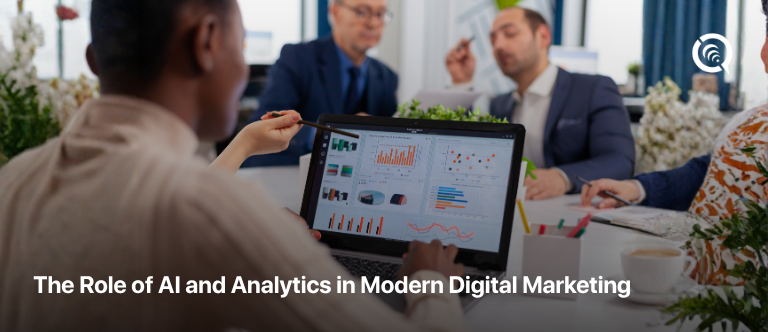
If you look at how marketing works today, one thing is clear. It is no longer driven by instinct alone. Data, automation, personalization, and prediction now shape almost every campaign. That is exactly why AI in Digital Marketing has become one of the most important topics for modern businesses.
A few years ago, marketers depended heavily on manual reporting, broad customer segments, and generic messaging. Today, brands can use AI and analytics in marketing to understand behavior patterns, personalize communication, improve timing, and optimize campaigns in real time. Instead of asking what might work, marketers can now ask what the data is already showing.
This shift matters because your audience is more informed, more distracted, and less patient than ever. You cannot rely on one-size-fits-all campaigns anymore. You need sharper targeting, smarter decisions, and better performance measurement. That is where artificial intelligence and analytics step in.
In this blog, you will learn how AI in Digital Marketing is changing campaign planning, customer engagement, and business growth. You will also see how digital marketing analytics tools, marketing data analytics, and machine learning in digital marketing work together to help brands make faster and more profitable decisions. If you want your marketing to become more efficient, more scalable, and more customer-focused, this is a shift you cannot afford to ignore.
Why AI in Digital Marketing Matters More Than Ever
The marketing environment has changed dramatically. Consumers interact with brands through websites, search engines, social media, email, online ads, chat platforms, and mobile apps. Every one of those interactions creates data. The problem is not the lack of information. The real problem is how to make sense of it quickly and use it effectively. That is why AI in Digital Marketing matters more now than ever before.
Artificial intelligence helps marketers move beyond manual analysis and repetitive tasks. It can identify patterns in customer behavior, predict likely outcomes, and automate actions based on real-time inputs. This is especially valuable when businesses are handling large volumes of campaign data across multiple channels. Instead of spending hours building reports and making guesses, teams can use AI to make faster and better decisions.
Another major reason AI matters is personalization. Customers expect content, offers, and experiences that feel relevant to them. They do not want broad campaigns that speak to everyone and no one at the same time. AI helps you segment audiences more accurately, recommend relevant products, personalize email sequences, and improve ad targeting. In simple terms, it helps you speak to the right person with the right message at the right moment.
It also improves efficiency. Modern marketers are under pressure to do more with limited time and resources. AI reduces the burden of manual tasks like reporting, lead scoring, campaign adjustments, and customer response management. That gives your team more room to focus on strategy, creativity, and growth.
Most importantly, AI makes marketing more measurable. It supports data-driven decisions instead of assumptions. When combined with analytics, it helps businesses understand what is driving results, what needs improvement, and where to invest next for maximum return.
How AI-Powered Marketing Strategies Improve Campaign Performance
Strong marketing is not just about being visible. It is about being relevant, timely, and persuasive. That is where AI-powered marketing strategies create a real advantage. They help brands improve campaign performance by combining data, automation, and predictive intelligence into day-to-day execution.
One of the biggest strengths of AI is audience targeting. Traditional campaigns often rely on broad demographic filters such as age, location, or gender. AI goes deeper. It studies browsing behavior, purchase patterns, engagement history, and intent signals to help marketers reach users who are more likely to convert. This reduces wasted spend and improves campaign quality.
AI also enhances personalization. For example, email campaigns can be customized based on previous interactions, website visits, or purchase history. Product recommendations can change based on customer behavior. Ad copy can be adapted for different audience groups. This level of personalization increases engagement because people respond more positively when content feels relevant to them.
Another important benefit is speed. AI can analyze campaign data much faster than a human team. If an ad is underperforming, bids can be adjusted. If a certain audience is converting well, budget can be shifted. If users are dropping off at a specific stage, marketers can spot it earlier and take action. This makes campaign optimization more dynamic and less reactive.
AI also helps with experimentation. Marketers can test multiple subject lines, ad creatives, landing page elements, and call-to-action variations at scale. The system learns from results and helps identify what works best. That means your campaigns improve over time instead of staying static.
In practical terms, AI does not replace marketers. It sharpens their decision-making. It helps you execute smarter campaigns, improve results, and scale successful strategies faster. In a competitive market, that is no longer a luxury. It is a serious growth advantage.
The Role of Analytics in Building Smarter Marketing Decisions
Marketing without analytics is like driving with your eyes half closed. You may still move forward, but you will not know whether you are going in the right direction. That is why analytics has become essential to modern marketing. When businesses invest in AI and analytics in marketing, they are not just collecting numbers. They are building a system for smarter decisions.
Analytics helps you understand how people discover your brand, how they interact with your content, where they drop off, and what finally drives conversion. Without that insight, it is difficult to improve campaign performance consistently. You may know that leads are coming in, but you will not know which channel is contributing the most value or which message is influencing action.
This is where digital marketing analytics tools become important. Tools such as Google Analytics, HubSpot, CRM dashboards, ad platform reports, and customer journey tracking systems help marketers turn activity into insight. They show which content performs best, which traffic source converts more effectively, and which customer segments are worth deeper attention.
Analytics also supports better budget allocation. If you know that one channel delivers low-cost qualified leads while another produces traffic with poor engagement, you can adjust spend accordingly. Instead of making emotional decisions, you make informed ones. That improves efficiency and helps your marketing budget work harder.
Another strength of analytics is performance measurement over time. Campaigns are not isolated efforts. They are part of a larger strategy. Analytics helps you compare results across weeks, months, and quarters. That allows you to spot patterns, identify seasonality, and understand long-term trends.
In short, analytics gives direction to your marketing. It tells you what is actually happening, what deserves attention, and what needs to change. When you combine that with AI, the value becomes even greater.
How Marketing Data Analytics Turns Raw Data Into Actionable Insight
Data by itself is not useful unless you can interpret it and act on it. That is the real purpose of marketing data analytics. It transforms raw numbers into practical insights that help you improve campaign results, customer understanding, and business growth.
Think about how much data marketing teams handle every day. Website visits, ad clicks, email opens, social engagement, keyword rankings, lead source data, purchase history, customer retention metrics, and more. Looking at all of that in separate reports is overwhelming. Analytics brings structure to that chaos. It connects data points and shows you what they mean in context.
For example, suppose your website traffic is growing but conversions are dropping. Without analytics, you might assume your site is doing well because the numbers look bigger. But deeper analysis may reveal that the traffic is low intent, landing pages are mismatched, or mobile users are abandoning the form. That changes your response completely.
Analytics also helps with segmentation. Not every customer behaves the same way. Some visitors are ready to buy. Others are still researching. Some interact with email more than ads. Some respond better to educational content than direct offers. Good analytics helps you identify these differences so your campaigns can become more focused and effective.
It also improves attribution. Many businesses struggle to understand which channel deserves credit for conversions. Was it SEO, email, retargeting, social media, or paid search? Marketing data analytics helps clarify the customer journey so you can invest in the channels that truly influence revenue.
Most importantly, analytics supports continuous improvement. You can test headlines, creatives, audience segments, landing pages, and offers, then measure results clearly. That creates a feedback loop where each campaign teaches you something valuable.
When used well, analytics does not just report the past. It helps shape better decisions for the future. That is what makes it one of the most powerful assets in modern marketing.
How Machine Learning Is Reshaping Modern Digital Marketing
If artificial intelligence is the broader system, then machine learning in digital marketing is one of the main engines driving it forward. Machine learning allows platforms and tools to learn from past data, identify patterns, and improve future decisions without being manually programmed for every single task. That is a major reason why digital marketing has become more adaptive and more intelligent.
In practical terms, machine learning helps marketers predict outcomes. It can forecast which leads are most likely to convert, which customers may stop engaging, which products a user is likely to buy, or which campaign variation might perform better. Instead of waiting until after a campaign ends, marketers can use these insights while campaigns are active.
Machine learning also improves automation quality. Basic automation follows fixed rules. Machine learning goes a step further by learning from behavior and outcomes. For example, an email platform may learn the best time to send messages to each subscriber. An ad platform may learn which audience characteristics are linked to stronger conversion rates. A recommendation engine may learn which products or content pieces are more likely to drive the next click.
Another major impact is on customer experience. Users now expect brand interactions to feel smart and relevant. Machine learning supports search personalization, chatbot responses, content recommendations, dynamic pricing models, and behavioral targeting. These features create smoother and more useful experiences for customers.
This matters because the competition for attention is intense. Brands that rely only on static campaigns often struggle to keep up. Meanwhile, businesses using machine learning can respond faster, personalize more effectively, and improve performance continuously.
As digital channels become more crowded, marketers need systems that can learn and adapt in real time. That is exactly why machine learning has become a central part of modern marketing success.
The Future of the Role of AI in Marketing and What Businesses Should Do Next
The role of AI in marketing will only become more important in the years ahead. We are moving toward a marketing landscape where automation, predictive intelligence, and personalized customer journeys are not optional extras. They are becoming standard expectations. Businesses that prepare early will have a stronger chance of staying competitive.
One major shift is the growth of predictive marketing. Instead of simply tracking past performance, brands will increasingly use AI to anticipate future behavior. This means forecasting churn, identifying likely buyers earlier, and tailoring offers before the customer even asks. Predictive capability will become a core advantage for brands that want to improve revenue efficiency.
Another important trend is greater integration across platforms. Today, many businesses still use separate tools for CRM, analytics, advertising, email, and content management. The future will push toward connected systems where AI can analyze signals from multiple touchpoints at once. That creates a more complete view of the customer and leads to better decision-making.
At the same time, human oversight will remain critical. AI can process data and automate decisions, but it still needs strategic direction. Marketers must define goals, protect brand tone, ensure ethical use of customer data, and apply creative judgment. The strongest businesses will not be the ones that hand everything over to machines. They will be the ones that combine AI efficiency with human insight.
So what should businesses do next? Start by identifying repetitive marketing tasks, weak points in campaign performance, and gaps in customer understanding. Then explore tools that can improve those areas. Focus on data quality, team readiness, and measurable goals. Build gradually instead of chasing every new tool.
The future belongs to brands that can learn faster and act smarter. AI gives you that opportunity. But it only creates value when it is tied to clear strategy, meaningful analytics, and consistent execution.
Key Applications of AI and Analytics in Marketing
To understand the value of AI in Digital Marketing, it helps to look at where it is already making a difference. The impact is not limited to one channel or one tactic. It stretches across the full customer journey, from awareness to conversion to retention.
Here are some of the most important applications:
- Predictive lead scoring: AI identifies which leads are more likely to convert, helping sales and marketing teams prioritize better.
- Personalized email marketing: Messages, timing, and offers can be customized based on user behavior.
- Content recommendations: Websites and platforms can suggest blogs, products, or services that match customer interest.
- Ad optimization: AI can adjust bidding, targeting, and placements in real time.
- Customer segmentation: Analytics helps divide audiences into meaningful groups based on behavior, not just demographics.
- Chatbots and instant support: AI-driven chat systems improve response speed and user experience.
- Customer journey analysis: Analytics reveals where people engage, hesitate, or drop off.
These use cases show why AI is no longer seen as experimental. It is already helping businesses improve efficiency and campaign performance.
Table: Traditional Marketing vs AI-Driven Marketing
| Area | Traditional Marketing | AI-Driven Marketing |
| Targeting | Broad audience segments | Behavior-based precision targeting |
| Personalization | Limited and manual | Scalable and dynamic |
| Reporting | Delayed and manual | Real-time and automated |
| Optimization | Based on periodic review | Continuous and predictive |
| Lead Qualification | Human-led and slower | AI-assisted and faster |
| Decision Making | Assumption-heavy | Data-driven and insight-led |
This comparison makes the shift easy to understand. AI-driven marketing does not just save time. It creates a more intelligent operating model.
How to Start Using AI and Analytics in Your Marketing
If you want to apply AI and analytics in marketing effectively, do not start with every tool at once. Start with a structured approach.
- Audit your current marketing setup
Review your channels, reporting systems, campaign goals, and data sources.
- Identify low-effort, high-impact use cases
Begin with areas like email personalization, lead scoring, campaign reporting, or chatbot automation.
- Choose the right digital marketing analytics tools
Use tools that fit your team’s skill level and business needs.
- Improve data quality first
Clean, organized, and consistent data makes AI output more reliable.
- Test, measure, and refine
Use analytics to evaluate performance and improve gradually.
- Keep humans involved
AI supports decisions, but your team still needs to guide messaging, creativity, and brand direction.
Frequently Asked Question
- What is AI in Digital Marketing?
AI in Digital Marketing refers to the use of artificial intelligence to improve marketing tasks such as audience targeting, campaign optimization, customer segmentation, personalization, and performance analysis. It helps marketers work faster and make better decisions using data instead of assumptions.
- How do AI and analytics work together in marketing?
AI and analytics complement each other. Analytics shows what is happening across your campaigns and customer journeys, while AI helps interpret that data, predict outcomes, and automate responses. Together, they create a more intelligent and efficient marketing system.
- What are the best digital marketing analytics tools for businesses?
Some of the most widely used digital marketing analytics tools include Google Analytics, HubSpot, Looker Studio, SEMrush, Ahrefs, and various CRM dashboards. The best choice depends on your goals, channels, reporting needs, and team capability.
- How is machine learning used in digital marketing?
Machine learning in digital marketing is used for predictive targeting, lead scoring, recommendation engines, ad optimization, send-time optimization, and customer behavior analysis. It helps systems improve over time by learning from campaign data and user actions.
- Is AI replacing digital marketers?
No, AI is not replacing digital marketers. It is helping them work smarter. AI handles data-heavy and repetitive tasks, but human marketers still lead strategy, creativity, storytelling, brand alignment, and ethical decision-making.
Conclusion
The growing influence of AI in Digital Marketing is not just a trend. It is a major shift in how modern marketing works. Businesses are no longer limited to manual reporting, generic campaigns, and delayed decision-making. With the help of AI, marketers can understand customers more deeply, personalize experiences more effectively, and improve performance more consistently.
At the same time, analytics remains the foundation that makes these improvements possible. Without insight, automation becomes guesswork. Without measurement, personalization loses direction. That is why the combination of AI and analytics in marketing is so powerful. One helps you understand what is happening, while the other helps you act on it faster and more intelligently.
The real opportunity for businesses is not just adopting tools. It is building a smarter marketing system. That means using digital marketing analytics tools to uncover patterns, applying marketing data analytics to guide decisions, and embracing machine learning in digital marketing where it can create measurable value.
If you want stronger campaigns, better targeting, improved efficiency, and more meaningful customer engagement, this is the direction you should be moving in. Start small if needed. Focus on clear use cases. Strengthen your data. Test consistently. Learn from results.
The brands that grow in the coming years will not be the ones with the most tools. They will be the ones that use intelligence, data, and strategy in the right way. That is the real role of AI in modern digital marketing, and it is only getting bigger.
Follow us on Linkedin | Instagram | Facebook or explore more insights at https://www.applogiq.org/